


The End of Times

Donations via PayPal
To donate, please click the "Donate" button.

Thank you very much for your interest in supporting the e-book manuscript The End of Times by Berthold Jerg.
Your help can make a significant contribution to making this work accessible to a wide readership and spreading it through professional translations into other languages.
If you would like to become a sponsor or supporter, you have the option to make a financial donation.
I thank you in advance for your support!

Sponsors and Donations Welcome

Time for the unveiling of secrets in artworks through heuristic image Analysis...
Novelty:
Heuristic image analyses of Christian artworks unlock previously inaccessible secrets.
This overcomes established interpretative boundaries and leads to novel insights...
Copyright © by Berthold Jerg, E-Mail: info@pscverlag.de





Heuristic image analyses are practical methods for understanding images and their symbols. They are frequently used in the fields of art and design and are based on established rules, principles, and traditions.
With experience and spiritual intuition, they help identify patterns and uncover the often hidden meanings within images. Techniques such as metaphors and defamiliarization are also employed in the process.
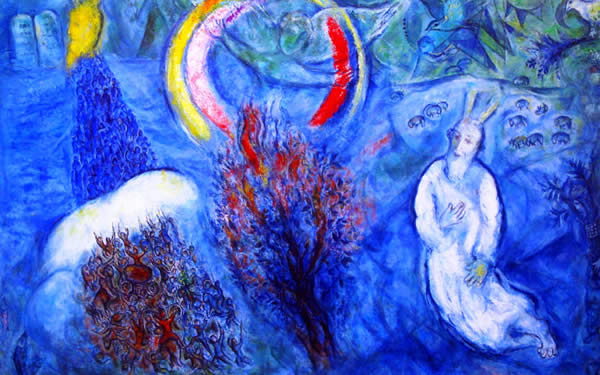
Marc Chagall’s large-scale oil painting "Moses and the Burning Bush" from the cycle "Biblical Message" presents three episodes from Moses’ life through its striking iconography. On the left, Moses is depicted with a yellowish head and small horns, gazing at the tablets of the commandments, which symbolize law and order. He appears as a divine leader, Son of God, and innovative pioneer of his people. His blue garment is composed of numerous human figures who follow him. A white cloud separates the upper from the lower world.
Beneath him, figures from purgatory and hell are sketched in red and blue, granted a new chance at a God-led life due to his sinlessness. In the center of the image, an angel with outstretched arms (marked in red) floats, representing love and the Holy Spirit. Its message is revealed in the burning bush, which visualizes the spiritual fire guiding humanity. The goddess of love connects the two sides of Moses and stands as a symbol of divine revelation and enlightenment.
On the right side of the painting, Moses appears as an aged God the Father in a bent posture (marked in light blue), symbolizing the burden of humanity’s sins. His spirituality and wisdom are emphasized by the prominently depicted big horns. He is surrounded by animals such as sheep, donkeys, and cows, which represent human souls trapped in the fallen existence of the animal realm of purgatory, where they atone for their sins. At the top edge of the image, a bird and a floating figure—the succeeding Son of God (marked in light green)—complete the spiritual continuity of the reborn Son of Man.
Marc Chagall (1887–1985), "Moses and the Burning Bush", oil on canvas, 195 x 312 cm. For heuristic image analysis, the work was altered with color markings. Created between 1960 and 1966; part of the cycle Biblical Message. Museum National Marc Chagall, Nice, France. Photomontage and interpretation by Berthold Jerg.


An example of a heuristic image analysis